
.webp)
Quick Answer
How Can Plastic Surgery Correct Breast Asymmetry?
Plastic surgery can correct breast asymmetry by increasing the smaller breast, reducing the larger breast, lifting one or both breasts, or adding carefully placed volume through fat grafting. Some patients benefit from a combination of these methods. The right treatment depends on the difference in breast size, breast shape, nipple position, skin quality, and existing breast tissue.
Key Takeaways
- Breast asymmetry may affect breast size, shape, position, or nipple alignment.
- Correction may involve augmentation, reduction, lift surgery, fat grafting, or multiple techniques.
- Surgery is customized because each breast may require a different procedure.
- Breast implants are not the only option for correcting uneven breasts.
- The goal is improved proportion and balance—not guaranteed perfect symmetry.
- Recovery and scarring depend on the procedures included in the surgical plan.
What Causes Breast Asymmetry?
Asymmetrical breasts can develop for many reasons. Uneven breast development during puberty is common, and some women naturally develop more breast tissue on one side. Differences may become more noticeable after pregnancy, breastfeeding, aging, or weight fluctuations.
Other potential causes include congenital conditions, trauma, changes following reconstructive surgery, or the results of previous breast surgeries. Existing breast implants may also contribute to an uneven appearance if they shift, rupture, or become affected by capsular contracture.
Breast asymmetry can involve more than cup size. A plastic surgeon will evaluate several factors, including:
- Breast volume and width
- Breast shape and projection
- Breast position on the chest
- Nipple and areola position
- Skin elasticity and excess skin
- The amount and distribution of natural breast tissue
- Previous surgical scars or implants
This detailed evaluation helps the surgeon identify the source of the asymmetry before recommending a surgical technique.
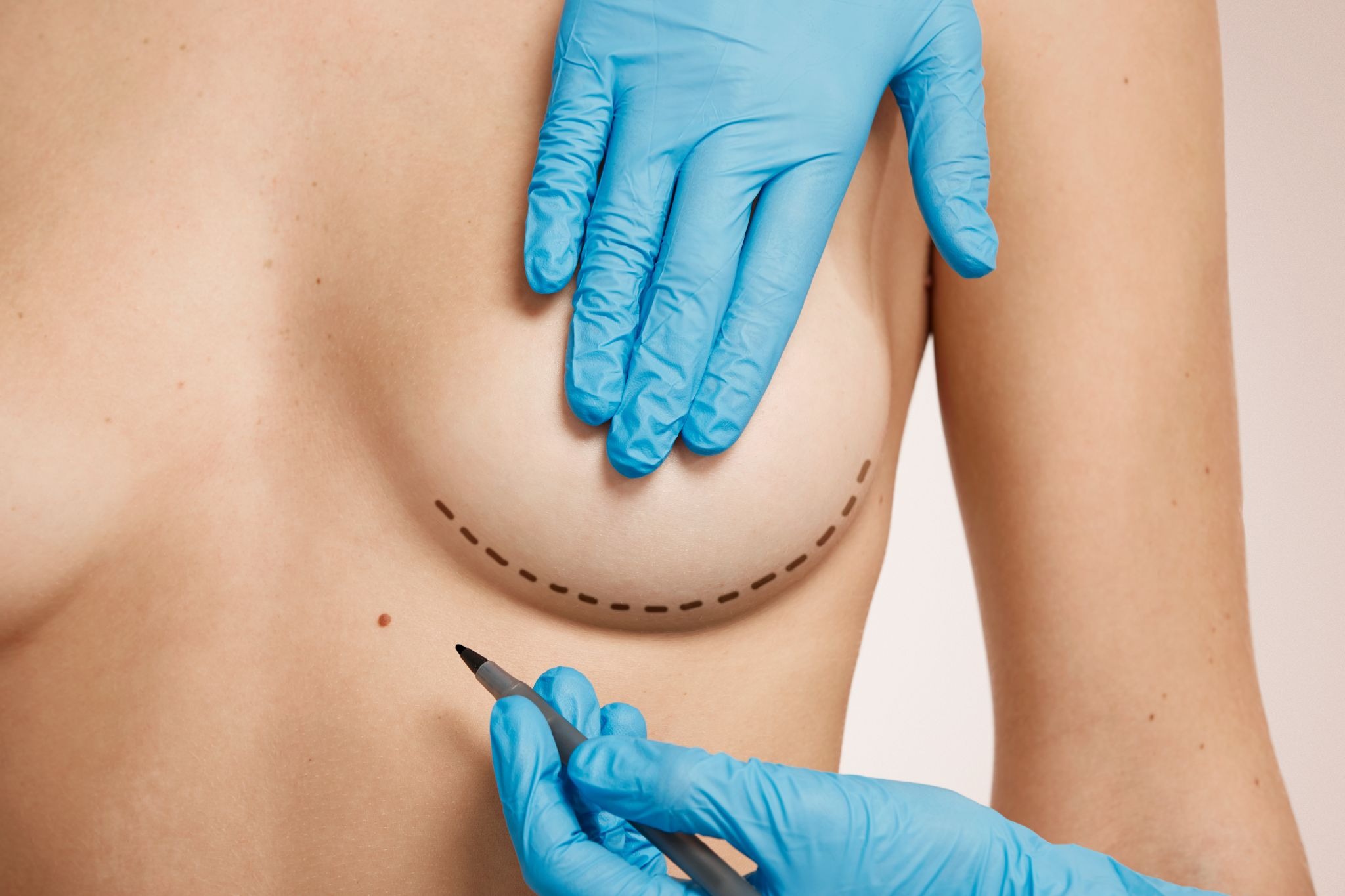
Breast Augmentation for a Smaller Breast
Breast augmentation may be appropriate when one breast has less volume than the other. An implant can be placed in the smaller breast to create a closer match, helping bring one breast to match the other more closely in size and shape, or implants of different sizes may be used in both breasts when the patient also wants an overall increase in breast size.
Implant size, profile, shape, and placement must be selected according to the anatomy of each breast, along with other factors that influence asymmetry and surgical planning. Although an implant can improve volume differences, it cannot always correct significant sagging or a low nipple position by itself. In those cases, augmentation may be combined with a breast lift.
Patients primarily interested in this approach can read more about how Ferguson Plastic Surgery may improve symmetry with breast augmentation. That article focuses specifically on implants, while breast asymmetry correction may include several other treatment options.
Patients considering implants should also understand their long-term requirements. According to the FDA’s breast implant safety information, breast implants are not lifetime devices. Future monitoring or additional surgery may be necessary, and risks should be reviewed carefully before treatment.
Breast Reduction for a Larger Breast
When one breast is significantly larger, breast reduction surgery may be used to remove excess breast tissue, fat, and skin from that side. The remaining tissue is reshaped to bring the breast into better proportion with the smaller breast and the rest of the body.
In some cases, both breasts undergo a breast reduction procedure, but different amounts of tissue are removed from each side. This can improve breast symmetry while reducing the overall breast size.
Reduction may be particularly helpful when uneven or overly large breasts contribute to physical concerns such as shoulder pressure, skin irritation, or difficulty finding supportive clothing. Explore the practice’s approach to breast reduction in San Antonio for more information about the procedure.
Breast Lift Surgery for Differences in Shape and Position
Breast size is only one part of symmetry. One breast may sit lower, have more excess skin, or have a nipple positioned differently from the other. A breast lift can reshape the existing breast tissue, remove stretched skin, and adjust the nipple and areola to create a more balanced appearance.
A lift may be performed on one or both breasts. Different surgical adjustments can be made on each side according to breast position and skin laxity. If volume is also uneven, the lift may be combined with breast augmentation or fat grafting.
Learn more about how a breast lift can improve breast shape and position. Incisions and permanent scars are part of lift surgery, although scars commonly soften and fade over time.
Fat Grafting for Breast Asymmetry Correction
Fat grafting offers another way to add volume without relying solely on an implant. During this procedure, fat is removed from another area of the body through liposuction, processed, and carefully injected into the breast that needs additional fullness.
This technique may be considered for relatively subtle volume differences or used alongside another breast procedure to refine shape and contour. Because not all transferred fat remains permanently, the amount of lasting volume can vary. More than one treatment may sometimes be needed to reach the desired result.
The patient must also have enough suitable donor fat. A consultation will determine whether fat transfer, implants, or another method offers the most appropriate approach.
Combining Procedures to Correct Asymmetrical Breasts
Breast asymmetry often involves multiple differences at once. One breast may be both smaller and lower, while the other may have greater volume but a different nipple position. Correcting those concerns may require different procedures for each breast.
A customized plan might include:
- An implant in the smaller breast and a lift on both sides
- Different implant sizes in the two breasts
- Reduction of the larger breast and lifting of one or both breasts
- A breast lift with fat grafting for additional shaping
- Implant revision following previous breast surgeries
Ferguson Plastic Surgery offers a range of breast procedures in San Antonio that can be tailored to the patient’s anatomy. The objective is to create a balanced appearance rather than force both breasts into an identical surgical plan.
Who Is a Good Candidate for Breast Asymmetry Surgery?
Ideal candidates are generally in good overall health, do not smoke, and have realistic expectations about surgery. Surgical options for uneven breasts are recommended by the American Society of Plastic Surgeons. Breast development should be complete, with fully developed breasts, and maintaining a relatively stable weight through a healthy lifestyle can help support lasting results.
During your consultation, be prepared to discuss pregnancy plans, medications, health conditions, previous procedures, and any history of breast changes. Your surgeon will examine both breasts individually and explain which differences can reasonably be improved.
It is important to understand that complete symmetry is not biologically realistic. Natural differences in the chest wall, ribs, muscle, skin, and breast tissue can remain after surgery. The goal is meaningful improvement and better balance—not mathematical perfection.
Recovery After Breast Asymmetry Correction
Recovery varies because breast asymmetry surgery may involve one procedure or a combination of techniques, but ideal candidates are healthy, non-smoking adults over 18 with fully developed breasts and a stable weight, since a healthy lifestyle helps support lasting results. Swelling, bruising, tightness, and soreness are expected early in the healing process, and procedures are often performed under general anesthesia. Patients may be asked to wear a supportive surgical bra, use pain medication as directed, and temporarily limit lifting, reaching, and strenuous exercise.
Some patients can return to desk-based work and light activities relatively soon, while combined or more extensive procedures may require additional time. Your personalized instructions should take priority over general recovery estimates.
Breasts can settle at different rates, so temporary unevenness during healing is not necessarily the final result. Swelling gradually subsides, incision lines mature, and breast shape continues to develop over the following months.
Choosing the Right Surgical Approach
There is no universal procedure for correcting uneven breasts. The best option depends on whether the primary concern involves volume, sagging, nipple alignment, breast position, or a combination of factors, and many cases are performed under general anesthesia as part of a customized surgical procedure.
Patients work closely with an experienced, Board Certified plastic surgeon so each breast can be evaluated separately while planning the overall result. Dr. Ferguson develops personalized plans using advanced surgical techniques based on the patient’s anatomy, preferences, health history, and realistic goals to help achieve desired results and optimal results.
This careful assessment helps achieve optimal results, and patients often notice immediate improvement in breast symmetry even while healing is still in progress. Swelling and soreness commonly last 1–2 weeks, and pain medication may be prescribed or recommended during recovery. Full results may take 3–6 months to appear.

Take the Next Step Toward Better Breast Balance
If uneven breasts affect your comfort or confidence, an individualized consultation can help you understand your options. Contact Ferguson Plastic Surgery & Aesthetics to discuss breast asymmetry surgery with Dr. Ferguson and develop a treatment plan based on your body and goals.
Frequently Asked Questions
Can breast asymmetry be corrected without implants?
Yes. Depending on the cause of the asymmetry, options may include breast reduction, a breast lift, or fat grafting. Implants are generally considered when additional volume is desired or needed.
Can surgery make my breasts perfectly symmetrical?
No procedure can guarantee complete symmetry. Differences in the chest wall, natural breast tissue, skin, and healing can remain. Surgery instead aims to create a visibly more balanced and proportionate appearance.
Can one breast receive a different procedure than the other?
Yes. One breast may require augmentation while the other undergoes reduction or lifting. Treating each breast according to its individual size and shape is often essential to correcting asymmetry.
Will breast asymmetry surgery leave scars?
Any procedure involving incisions will produce scars. Their location and extent depend on whether the plan includes implants, reduction, lifting, or fat grafting. Scars are permanent but typically change and soften as they mature.
How long do the results last?
Results can be long-lasting, but aging, pregnancy, weight changes, gravity, and changes in breast tissue can affect breast shape over time. Implants also require ongoing monitoring and may eventually need revision or replacement.
.png)

.png)